

The Complete Guide to Full Mouth Dental Implants
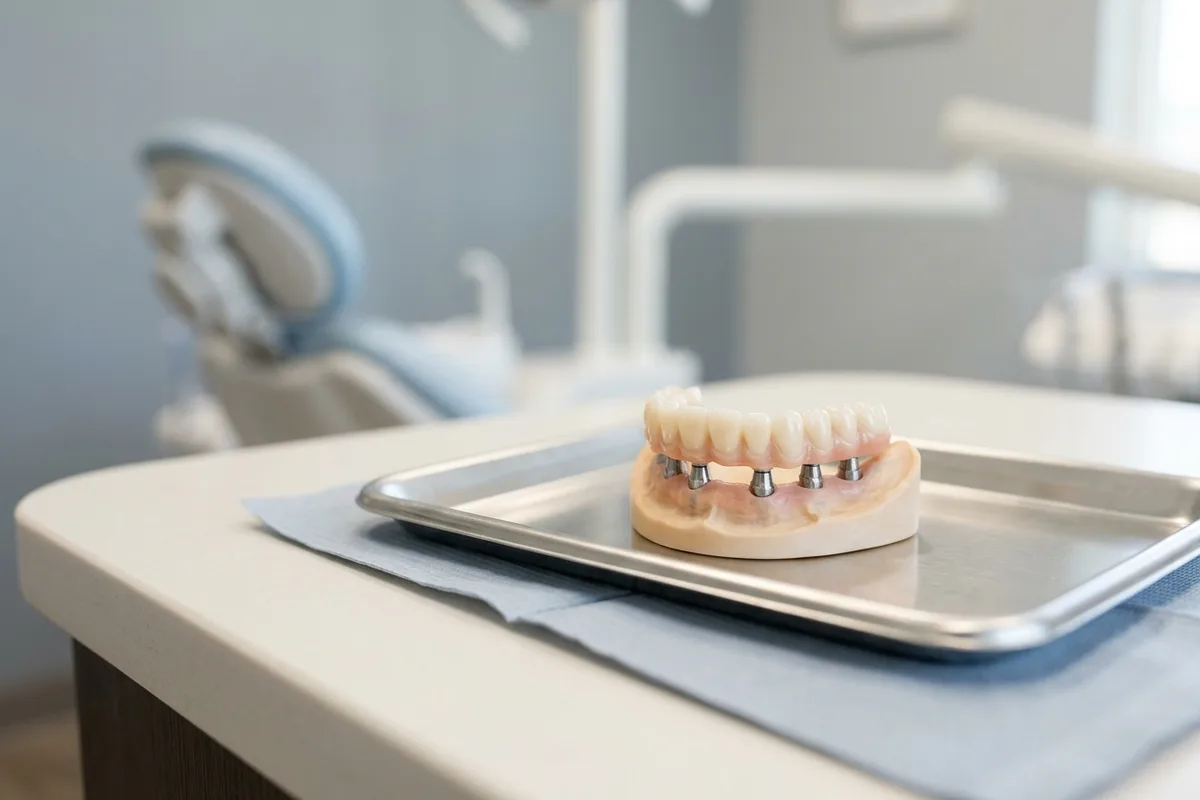
Discover how full mouth dental implants restore chewing and halt bone loss using removable overdentures or fixed bridges, along with key healing stages, daily care, and cost considerations.
Full Mouth Dental Implants at a Glance (Key Facts)
Full mouth dental implants replace an entire upper or lower arch of missing teeth using secure titanium posts anchored directly into the jaw. This care matters because losing natural teeth allows the jawbone to shrink over time, which affects bite strength, facial support, and day-to-day comfort.[1][2][3]
- Lower jaw overdentures supported by two implants achieve high predictability, with success rates often exceeding 95 percent.
- Traditional complete dentures allow jawbone shrinkage of several millimeters each year, which implant solutions help halt by distributing chewing forces.
- Restoring an upper jaw with an overdenture generally requires at least four implants, compared to a minimum of two in the lower jaw.
- Stud attachments manage varying implant angles, tolerating from 10 to 15 degrees with ball attachments up to 50 degrees with OT Equator systems.
- Fixed hybrid restorations require substantial vertical clearance, needing at least 12 to 15 mm of space in the lower jaw.
What Are Full Mouth Dental Implants? (Quick Definition)
Full mouth dental implants refer to comprehensive restorations that replace a full set of upper or lower teeth using surgically placed implant fixtures. These restorations can take the form of removable implant-supported overdentures or fixed hybrid bridges made of metal and acrylic resin that screw directly into the jaw.
People often confuse full mouth implants with traditional complete dentures. While traditional dentures rest entirely on gum tissue and allow the underlying ridge to shrink by several millimeters each year, full-arch implant restorations anchor securely to bone. This solid connection prevents unwanted movement and distributes chewing forces to preserve your jaw structure.[1][2][3]
Who It Suits
Patients Who Benefit Most
Full-arch implant restorations suit individuals who have lost all their teeth or face the loss of an entire dental arch. A removable overdenture anchored by two implants serves as a first-choice baseline of care for a toothless lower jaw, providing dependable retention, stability, and high patient satisfaction.[1][3]
Cases Requiring Extra Planning
Patients with limited bone volume in the upper jaw or reduced clearance between dental arches require customized planning. Upper arches generally require four or more implants due to softer bone quality, and patients with close sinus cavities may benefit from front-positioned implants to avoid bone grafting.[1][3]
How Full Mouth Dental Implants Work (Step by Step)
Step 1: Vertical Space Assessment
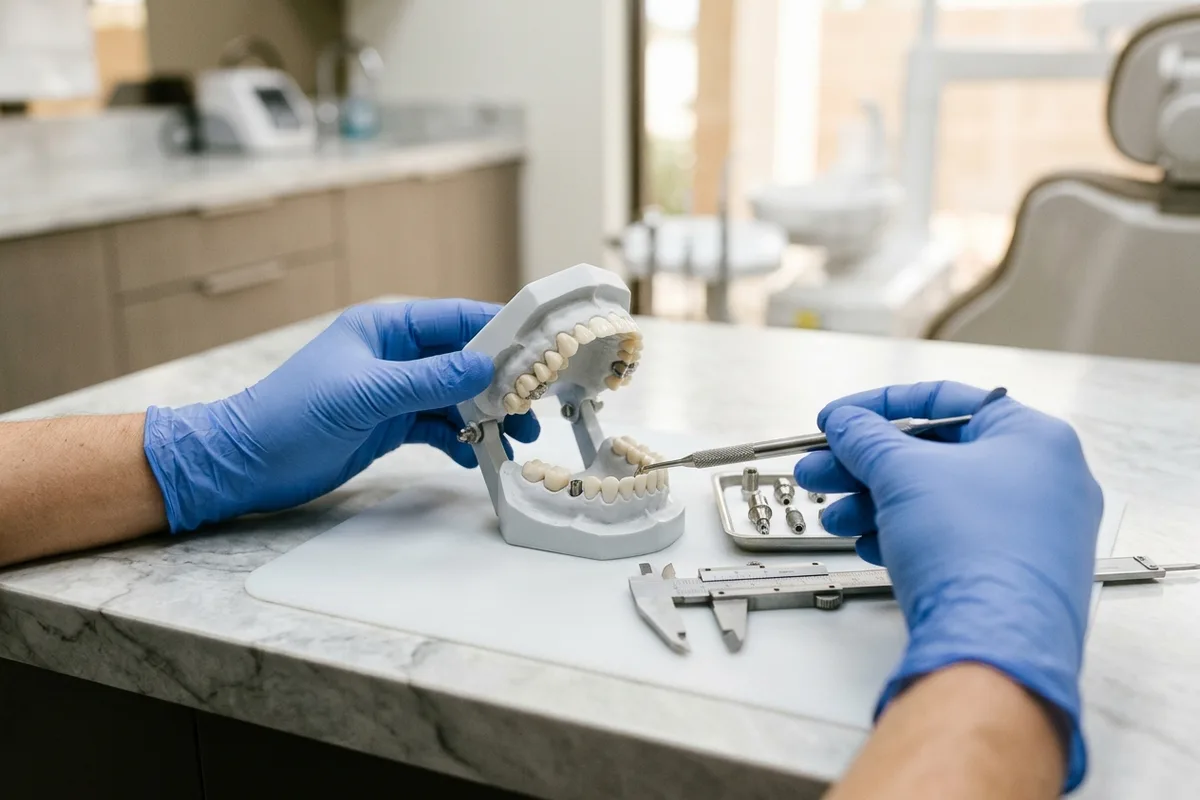
Your dentist evaluates bone structure and measures the vertical space between your opposing jaws. Different attachment systems require specific clearance, ranging from 7 to 9 mm for compact studs up to 13 to 15 mm for bar attachments or fixed hybrid bridges.[1][2]
Step 2: Surgical Implant Placement
Your dentist surgically places titanium implants into strategic positions in the jaw. Placing two to three implants in the front upper jaw and two in the front lower jaw avoids anatomical boundaries like the sinus cavities and nerve canals.[1][3]
Step 3: Healing and Bone Bonding
A healing period of six to seven months may be allowed for the bone to firmly bond with the titanium posts. Once bonding occurs, your dentist uncovers the fixtures and places healing caps on top of them to shape surrounding gum tissue.[3]
Step 4: Connecting the Final Prosthesis
About two weeks after healing caps are placed, attachment studs are connected. For removable overdentures, metal housings are bonded inside the denture base using acrylic resin while a protective rubber barrier shields the gums.[3]
Types and Options
Full-arch restorations vary based on whether they remain fixed in place or snap off for daily cleaning, as well as the vertical clearance needed to house the attachment hardware.
| Restoration Option | Attachment Style | Vertical Space Needed | Key Characteristics |
|---|---|---|---|
| Two-Implant Mandibular Overdenture[1] | Stud attachments (Ball, Locator, or OT Equator) | 7 to 12 mm depending on stud | First-choice standard for toothless lower jaw with over 95% success |
| Four-Implant Maxillary Overdenture[1] | Studs or splinted bar system | 8.5 to 14 mm depending on system | Required minimum for upper jaw to balance softer bone anatomy |
| Fixed Lower Hybrid Bridge[2] | Screw-retained metal-acrylic framework | At least 12 to 15 mm | Non-removable bridge that reduces chewing force impact and restores lip support |
Choosing Attachment Hardware
Attachment systems accommodate different angles between implants. Compact ball attachments tolerate up to 10 to 15 degrees of divergence, Locator studs manage up to 40 degrees, and OT Equator systems accommodate up to 50 degrees while requiring only 7 to 7.5 mm of clearance.[1]
Recovery and Care
Daily Cleaning at Home
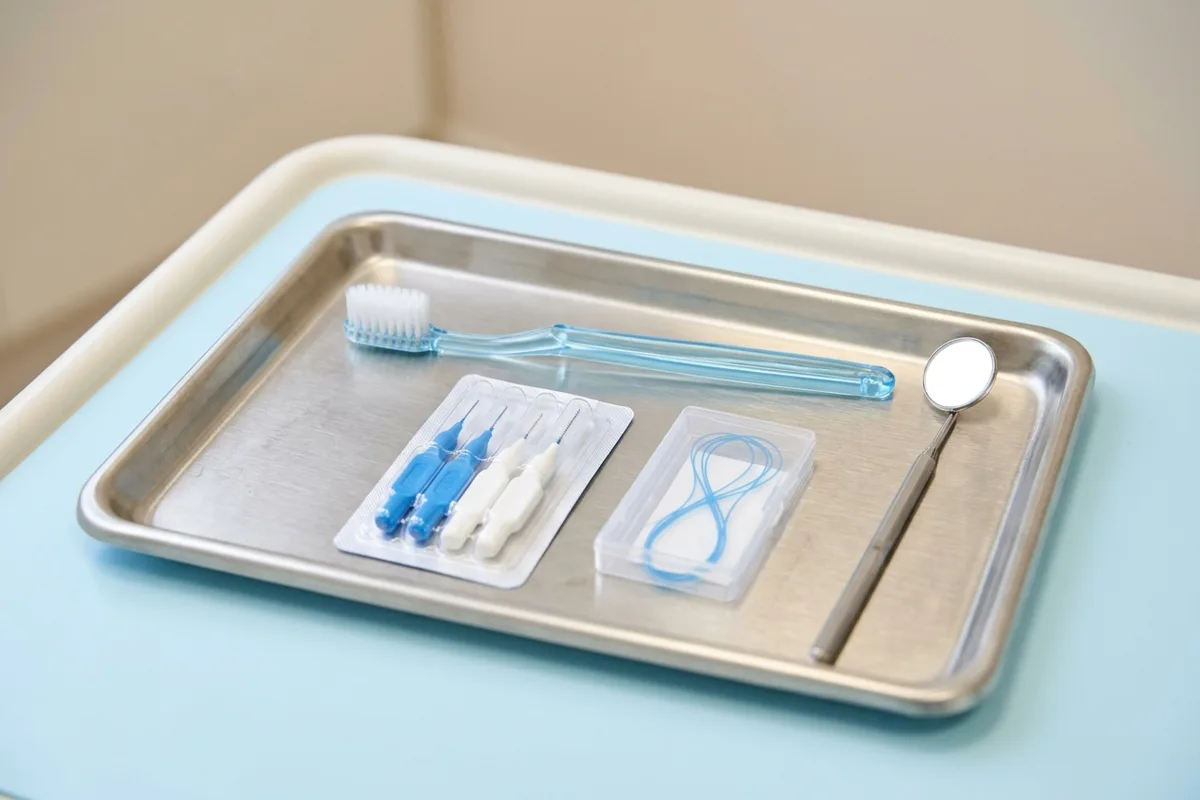
Diligent daily oral hygiene is essential to protect gums and underlying bone from infection. Patients wearing fixed hybrid prostheses must use specialized tools like super floss and water flossers to clear food particles that collect underneath the framework.[1][2]
Routine Professional Checkups
Regular examinations with your dentist help detect early complications and maintain bone health around implants. Patients with fixed hybrid restorations should undergo clinical and radiographic follow-up exams every 6 to 12 months to assess stability and bone levels.[1][2]
Common Mistakes to Avoid
Avoiding common pitfalls during planning, surgery, and home maintenance protects your implants and keeps your replacement teeth stable for years to come.[1][2]
- Skipping daily cleaning underneath fixed bridges, which invites food trapping, severe gum inflammation, and bone loss around implants.
- Exceeding implant angle limits during planning, which increases bone stress, causes loose screws, and accelerates attachment wear.
- Overlooking the necessity of a completely passive framework fit, which can trigger screw loosening, bone loss, or fixture breakage.
- Extending lower hybrid bridge frameworks beyond a 15 to 20 mm backward cantilever, which risks structural metal fracture.
Risks
Biological Risks and Peri-Implantitis
Implant-supported restorations carry risks of implant failure and peri-implantitis, a severe gum inflammation accompanied by progressive bone loss around fixtures. Upper jaw overdentures show variable survival rates from 72.4% to 100%, largely reflecting lower bone quality in the posterior maxilla.[1]
Mechanical Wear and Maintenance Issues
Fixed hybrid restorations can trap food and cause slight speech changes during initial adaptation. Over time, artificial acrylic teeth may chip or wear down, and resin coverings placed over screw holes can dislodge, requiring routine maintenance.[2]
What Affects the Cost
The overall cost of full mouth dental implants depends on several clinical and restorative factors. The specific treatment path you choose makes a major difference, as a removable overdenture requires different planning than a fixed hybrid bridge. In addition, the number of implants placed directly affects treatment scope; while a lower arch can often succeed with two implants, the upper jaw generally requires four or more due to softer bone density.
Material choices also shape total treatment fees, because metal-acrylic hybrid prostheses cost less to fabricate than metal-ceramic alternatives. Your overall expense is further influenced by the number of visits needed for surgical healing, attachment pickups, and follow-up adjustments, alongside your dental insurance coverage. Before starting care, you can ask Dr. Yiyang Zou at One Ounce Dental for a complete fee breakdown based on your individual needs.[1][2]
Words You May Hear
Your dental team may use several clinical terms when explaining full mouth dental implants. Understanding these terms will help you feel informed during your treatment visits.[1][2][3]
- Overdenture: a removable full denture anchored onto dental implants that stabilizes your bite and helps stop progressive jawbone shrinkage.
- Hybrid prosthesis: a fixed metal-acrylic resin bridge screwed directly into dental implants to replace uncomfortable traditional dentures.
- Cantilever: the unsupported backward extension of a fixed bridge framework, typically restricted to 15 to 20 mm in the lower jaw.
- Peri-implantitis: severe gum inflammation accompanied by progressive bone loss around supporting dental implants.
- Inter-arch space: the vertical distance between opposing jaws, requiring anywhere from 7 mm for compact studs to 15 mm for fixed bridges.
Sources
- Advances in Implant-Supported Overdentures: A Review of Recent Attachment Systems — pmc.ncbi.nlm.nih.gov
- Implant-supported hybrid prosthesis: Conventional treatment method for borderline cases — pmc.ncbi.nlm.nih.gov
- Implant-Supported Overdenture Using Ball Attachments in Maxilla and Mandible: A Case Report — pmc.ncbi.nlm.nih.gov
Common questions
Frequently asked questions
Questions about your own smile?
Request an appointment at One Ounce Dental in Chino, CA, to discuss your restorative options. Our team is available Monday through Saturday to answer your personal treatment questions.
More Articles
View all Dental care
Why Do I Have a Metallic Taste in My Mouth? 7 Common Causes
A lingering metallic flavor can come from swollen gums, everyday drugs, sinus colds, or dry mouth. Learn what causes this strange taste and how to find relief.November 17, 2026 · 6 min read Dental care
Why Is My Tongue White? 7 Common Causes
A white tongue can stem from harmless debris, surface irritation, fungal thrush, or precancerous patches. Discover what causes these color changes, how to spot warning signs, and when to seek dental care.November 16, 2026 · 6 min read Dental care